Abdi Yousuf Muhumed, Abenet Belete and Michael Akwasi Antwi
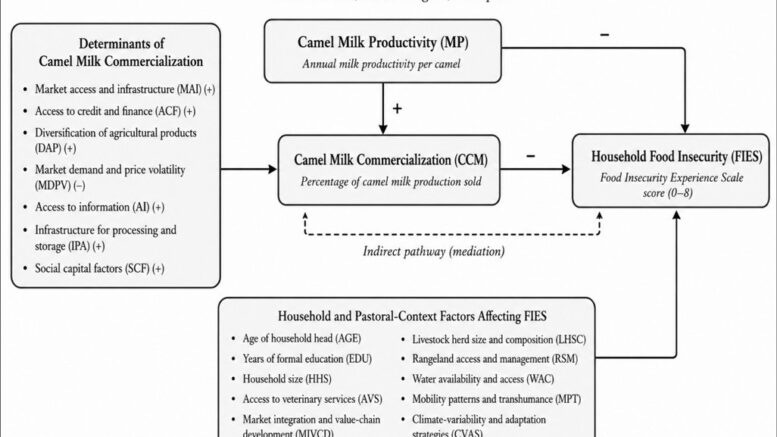
Camel milk is central to pastoral diets, income, and livelihood strategies in Ethiopia, yet evidence linking its commercialization to household food insecurity remains limited. This study examined factors associated with camel milk commercialization (CCM) and the direct and indirect associations of milk productivity with household food insecurity among 385 camel milk-producing households in the Shebelle Zone, Somali Region. Cross-sectional survey data collected during the 2024 – 2025 agricultural production season were analyzed using an observed-variable structural path model estimated by maximum likelihood in international business machines (IBM) statistical package for the social sciences (SPSS) analysis of moment structures (AMOS) version 31. Commercialization was measured as the percentage of total camel milk production sold, whereas household food insecurity was measured using the eight-item food insecurity experience scale (FIES) raw score (0 – 8), with higher values indicating greater food-insecurity severity. The model demonstrated good absolute and approximate fit, although incremental fit indices were comparatively weaker: Chi-square (χ²) (153) = 232.313, p < 0.001; Chi-square statistic (CMIN)/ degrees of freedom (DF) = 1.518; goodness-of-fit index (GFI) = 0.942; adjusted GFI (AGFI) = 0.920; comparative fit index (CFI) = 0.885; Tucker–Lewis index (TLI) = 0.857; incremental fit index (IFI) = 0.891; and root mean square error of approximation (RMSEA) = 0.037, 90% confidence interval (CI): 0.027, 0.046, p-value for close fit (PCLOSE) = 0.992. The model explained 59.4% of the variance in CCM and 46.2% in FIES. Milk productivity was positively associated with commercialization (B = 0.492 per 100 L/camel/year, β = 0.131, p < 0.001), whereas commercialization was negatively associated with FIES (B = −0.052 per percentage point, β = −0.330, p < 0.001). Milk productivity also had a significant negative direct association with FIES (B = −0.069, β = −0.117, p = 0.002). The standardized indirect productivity–commercialization–FIES association was negative and significant (β ≈ −0.043; bias-corrected 95% CI: −0.069, −0.023, p < 0.001), while the standardized total association was −0.160. Institutional, household, and pastoral-context variables were also associated with the two outcomes. Because the study is cross-sectional, all estimates are interpreted as conditional statistical associations rather than causal effects.
Published on: June 26, 2026
doi: 10.17756/jfcn.2026-232
Citation: Muhumed AY, Belete A, Antwi MA. 2026. Camel Milk Commercialization and Its Association with Household Food Insecurity among Pastoralists in the Shebelle Zone, Somali Region, Ethiopia. J Food Chem Nanotechnol 12(2): 81-93.